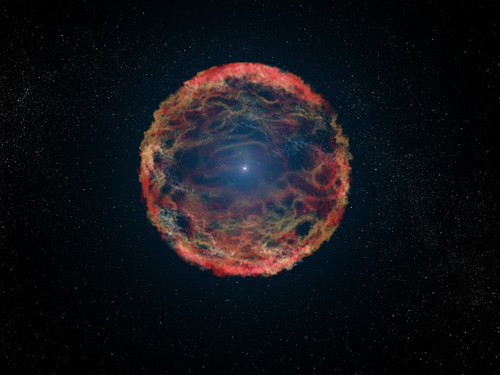
Hubble supernova discovery has captured the attention of astronomers worldwide. NASA’s Hubble Space Telescope recently completed its 200,000th orbit while investigating a recurring supernova, shedding light on these fascinating cosmic phenomena.
What is the significance of Hubble’s 200,000th orbit?
The recent completion of Hubble’s 200,000th orbit around Earth marks a significant milestone in the field of astronomy. This achievement not only showcases the longevity and resilience of the telescope but also highlights its ongoing contributions to our understanding of the universe. One of the key aspects of this milestone is the telescope’s role in the discovery of phenomena such as the reappearing supernova, a focus of ongoing research.
Hubble’s observations have provided valuable insights into the life cycles of stars and the mechanics of supernovae. The ability to track celestial events over time allows scientists to piece together the history and evolution of these explosive occurrences. In particular, the detection of the reappearing supernova demonstrates Hubble’s unparalleled capability to monitor changes in the cosmos.
The significance of this achievement extends beyond just the numbers. It underscores the importance of continued investment in space exploration and the technologies that make such discoveries possible. As we celebrate this milestone, it becomes clear that Hubble’s legacy is intertwined with groundbreaking discoveries, making the Hubble supernova discovery one of the many highlights of its storied mission.
How does Hubble hunt for supernovae?
The Hubble Space Telescope employs a variety of sophisticated techniques to hunt for supernovae, allowing astronomers to capture the dramatic moments of stellar explosions. One of the primary methods involves monitoring galaxies for changes in brightness over time, particularly in regions known to host massive stars. When a star reaches the end of its life cycle, it can explode as a supernova, temporarily outshining entire galaxies. Hubble’s high-resolution imaging capabilities enable scientists to detect these fleeting events with remarkable precision.
To enhance its chances of discovering supernovae, Hubble utilizes the following strategies:
- Wide-field surveys: Hubble conducts extensive surveys of nearby galaxies, capturing images over multiple nights to identify any fluctuations in brightness.
- Targeted observations: Once a potential supernova is identified, Hubble can focus on that specific region, gathering detailed data on the explosion and its aftermath.
- Collaboration with other observatories: Hubble often works in tandem with ground-based telescopes and other space missions, sharing data to enhance overall discovery efforts.
Through these methods, the Hubble supernova discovery process not only contributes to our understanding of the universe but also celebrates Hubble’s enduring legacy as a premier astronomical observatory.
Key findings from Hubble’s latest observations
The latest observations from the Hubble Space Telescope have yielded significant insights into the phenomenon of supernovae. This remarkable achievement comes as Hubble completes its 200,000th orbit, showcasing its enduring capability to advance our understanding of the universe. Here are some key findings from these observations:
- Discovery of a reappearing supernova: Hubble’s observations have led to the identification of a supernova that appears to be repeating, a rare occurrence that could provide new insights into the lifecycle of stars.
- Illuminating star formation: The data collected from Hubble’s observations is helping astronomers understand how supernovae contribute to the formation of new stars and the enrichment of galaxies with heavy elements.
- Expanding cosmic knowledge: These findings enhance our knowledge of the universe’s expansion rate and the role of dark energy, further solidifying Hubble’s role as a cornerstone in astronomical research.
- Technological advancements: Hubble’s ability to capture high-resolution images and spectra of distant galaxies is unparalleled, allowing scientists to analyze supernova remnants in unprecedented detail.
These discoveries underscore the importance of the Hubble supernova discovery in the broader context of astronomical exploration and highlight its lasting impact on our understanding of the cosmos.
The importance of the recurring supernova
The discovery of a recurring supernova is pivotal in understanding the life cycles of stars and the evolution of galaxies. This phenomenon not only challenges existing theories but also provides a unique opportunity to study the physics of stellar explosions in detail. The Hubble supernova discovery has opened new avenues for research, allowing astronomers to gather crucial data on how these cosmic events occur and their implications for the universe.
Researchers emphasize the significance of observing supernovae that repeat over time. This allows them to:
- Track changes in the supernova’s behavior across different occurrences, offering insight into the underlying mechanisms of stellar explosions.
- Measure distances in the universe more accurately, as certain types of supernovae serve as reliable “standard candles” for cosmic distance measurement.
- Investigate chemical enrichment in the interstellar medium, as explosions release heavy elements that contribute to the formation of new stars and planetary systems.
The Hubble supernova discovery, therefore, not only represents a significant milestone for the telescope but also enhances our understanding of fundamental astrophysical processes that shape the cosmos.
Future missions for Hubble and beyond
The Hubble supernova discovery has reignited discussions about the future of space telescopes and the ongoing mission of the Hubble Space Telescope. As Hubble continues to orbit Earth, scientists are already planning ambitious missions that could enhance our understanding of the universe.
Future missions for Hubble and beyond may focus on:
- Advanced Technology: Upcoming telescopes, such as the James Webb Space Telescope, are set to complement Hubble’s capabilities by observing infrared light, allowing scientists to see deeper into the universe.
- Collaboration: International collaborations between space agencies may lead to joint missions that can observe supernovae across different wavelengths, providing a more comprehensive picture of these cosmic events.
- New Discoveries: Future missions will aim to explore not only supernovae but also exoplanets and the cosmic background radiation, expanding our understanding of the fundamental workings of the universe.
The Hubble supernova discovery is just a glimpse of the possibilities that lie ahead in astronomical research. As technology advances, astronomers are hopeful that future discoveries will be even more groundbreaking, offering insights that could reshape our understanding of the cosmos.
What does this mean for space exploration?
The recent Hubble supernova discovery marks a significant milestone in our understanding of the cosmos and the evolution of stars. As Hubble continues to provide invaluable data, its findings have profound implications for future space exploration.
One of the most exciting aspects of this discovery is the potential to unravel the mysteries of dark energy and the expansion of the universe. By studying supernovae, astronomers can gain insights into the rate at which the universe is expanding. This knowledge is crucial for developing accurate models of cosmic evolution.
Moreover, Hubble’s ability to observe supernovae over time allows scientists to track their behavior and characteristics. This long-term monitoring can lead to breakthroughs in our understanding of stellar life cycles and the underlying physics of these explosive events.
In addition, the technology and methodologies developed for Hubble’s observations are paving the way for future missions. Upcoming telescopes, such as the James Webb Space Telescope, will build upon Hubble’s legacy, further enhancing our capability to explore distant galaxies and the fundamental forces shaping our universe.
Ultimately, the discoveries made by Hubble not only deepen our knowledge but also inspire a new generation of scientists to explore the final frontier.
The Hubble supernova discovery has provided astronomers with unprecedented insights into the life cycles of stars. As researchers continue to analyze the data, the Hubble supernova discovery may reshape our understanding of cosmic events.
By NASA Goddard Photo and Video via Openverse